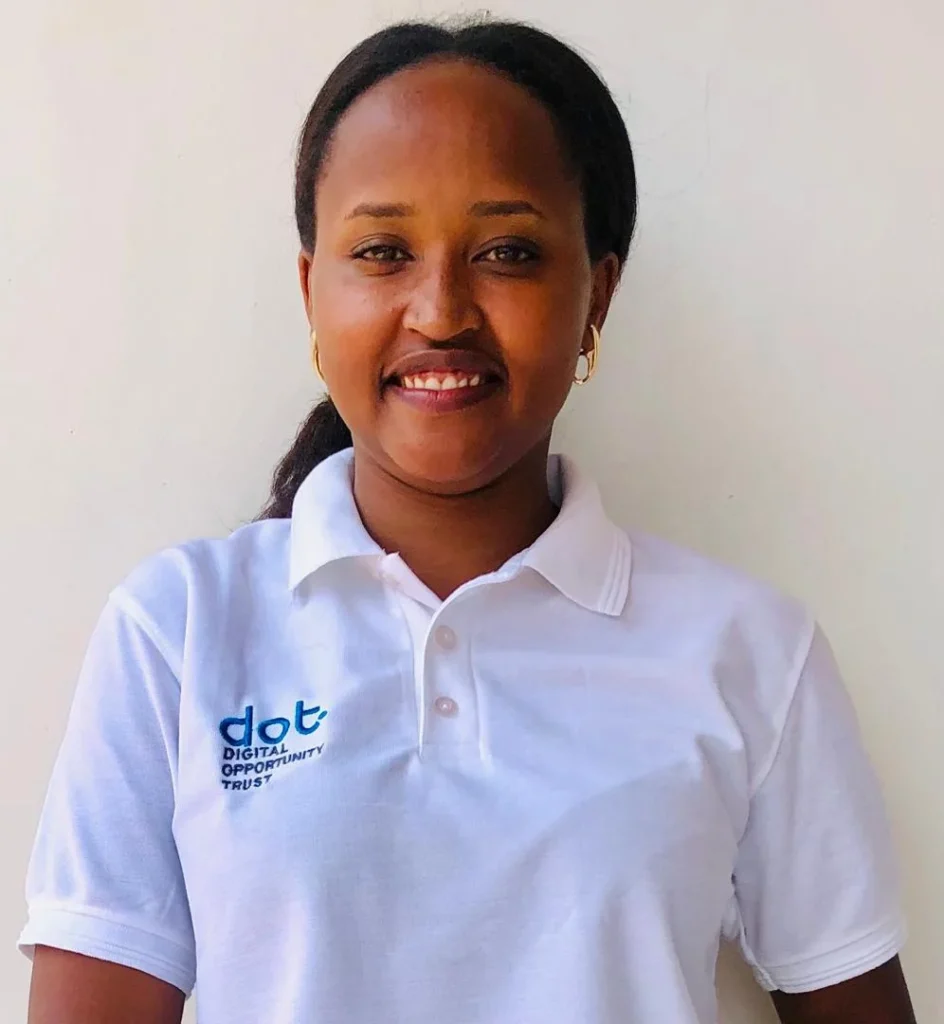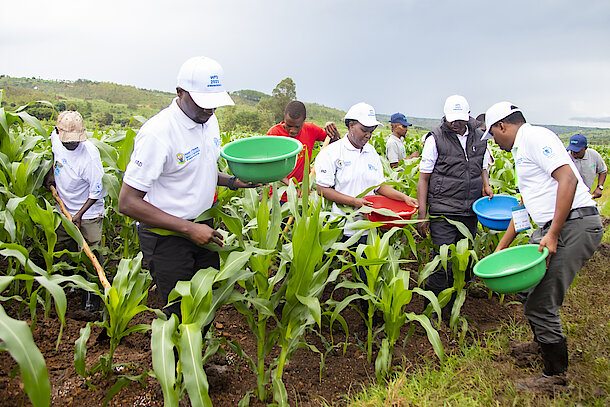
Farming is in Phionah’s blood. She grew up on a farm in the Eastern Province of Rwanda, helping her family tend to their fields of maize and beans. “Agriculture was my passion from the beginning,” she says. So when it came time to choose a field of study in university; the decision was also a no-brainer – crop science. “I always wanted to do something that I could take back to my community,” she says. Working with Rwandan farmers, Phionah often heard complaints about erratic rainfall and poor harvests, and began to recognize the links between those experiences and global warming. “What motivated me to become a climate activist is how I saw climate change affecting my own community,” she explains.
When Phionah saw an advertisement for the DOT Climate Champion program, she knew she had found a perfect fit. “I wanted to see my community adapt, but also to believe in their power to make change for themselves,” she explains. But that required unraveling old ways of thinking. “A lot of people have the mindset that there is no climate change,” she says. Phionah knew it wouldn’t work to simply tell them they were wrong. Rather, she tried to slowly chip away at that belief. “Effective climate action always starts by listening,” she says. “You have to understand how people experience [environmental] changes.” Then came conversations with participants discussing the prolonged droughts that were becoming more frequent, and what it might take to adapt to them. “Our project was participatory in that the idea was to get the community involved in every step of the process,” Phionah says.
However, she faced other challenges as well. “In my community, if you are a young woman, it is hard for people to trust that you are bringing something to the table,” she explains. In particular, many people “weren’t used to seeing young women lead conversations about farming.” But participants’ views softened when they realized that Phionah wasn’t claiming to be an expert trying to solve their problems, but rather that they would “own and lead the solution” to their own challenges. “[I] showed respect for their experiences,” Phionah says, “and as a result they valued my contributions too.”
Under Phionah’s guidance, the community came up with a creative twist on a popular institution: the ‘Communal Savings Group’. Members of these groups contribute a small amount to a communal pot each month, and the money is paid out to one person on a rotating basis. In Phionah’s community, these groups act as both an informal financial institution and a social organization. So her climate action participants decided to create a savings group focused specifically on “saving money for farming needs associated with climate change,” she explains. The idea was for members to use their payouts to fund projects to improve their ability to withstand climate shocks, such as improving the irrigation system on their farm or planting trees to stop soil erosion. Beyond that, the group became a place where members could share information about climate change and how to adapt to it. “It creates awareness and at the same time, it has practical value,” Phionah explains.
For Phionah, the experience of being a Climate Champion has fundamentally reshaped the way she understands leadership. “This project taught me that real change takes patience and continued engagement,” she says. For a solution to be effective, it had to be rooted in local needs and knowledge, so that “even after we are done, the community can continue.” Being a Climate Champion taught Phionah to lead by facilitating, rather than directing from above. “I have learned that engagement works best when the community leads the process,” she observes. Finally, becoming a Climate Champion helped her realize her potential as a leader. “I have grown in confidence that as a young woman, I can create impact in communities,” she says. “Leadership is not about age or gender.”